

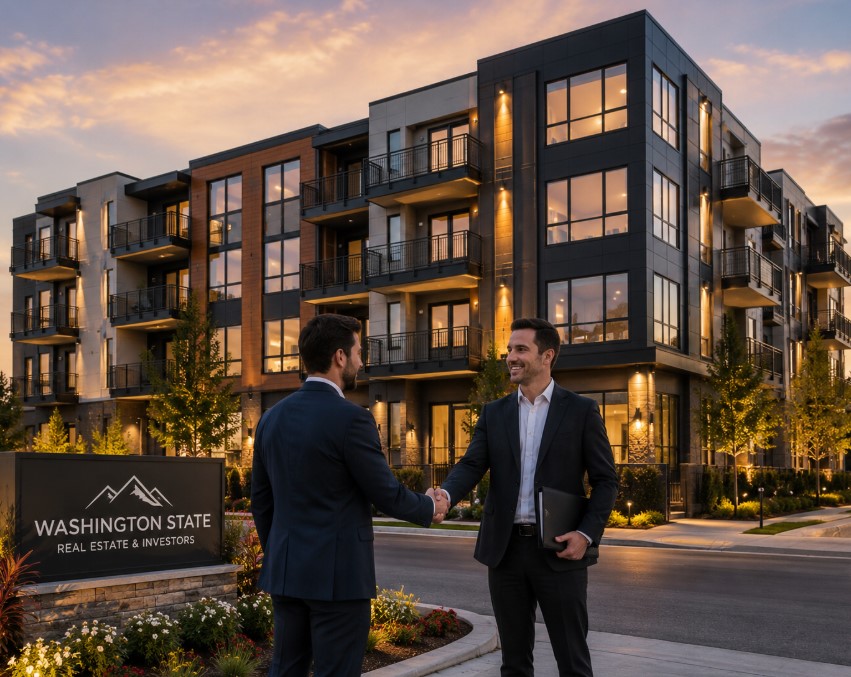
What Is Drawing Property Investors to Washington State Right Now
Washington State real estate has quietly become one of the most attractive investment markets in the western United States. Washington State does not always come up first in conversations about real estate investment. California gets the headlines, Florida gets the volume, Texas gets the momentum stories. But quietly, and fairly consistently, Washington keeps showing up on the radar of serious property investors, and the reasons are worth understanding.
This is not a market chasing hype. It is a market supported by genuine fundamentals: a growing population, a diversified economy anchored by some of the world’s largest technology companies, constrained land supply in desirable areas, and a geography that naturally limits sprawl. Those conditions tend to produce durable property values over time, which is exactly what patient investors look for.
According to the University of Washington’s Washington Center for Real Estate Research, Washington State continues to face significant housing supply constraints relative to demand, a dynamic that has supported price stability even as broader national markets adjusted through 2023 and 2024. Statewide median prices showed 0.9% growth in the second quarter of 2025 year-over-year, a modest but steady signal in a period when many markets were pulling back.
While states like Texas, Florida, and California often dominate headlines, Washington State real estate continues to attract savvy investors seeking long-term appreciation, strong rental demand, and economic stability. Supported by a thriving technology sector, ongoing population growth, and limited housing supply, Washington State real estate offers opportunities across a variety of markets, from high-end urban centers to emerging value-driven communities.
Seattle and the Eastside
Seattle is the obvious starting point, though it is less about entry-level opportunity and more about long-term appreciation in established corridors. The tech employment base, anchored by Amazon, Microsoft, and a dense network of supporting companies, sustains housing demand in ways that are difficult to replicate elsewhere. Neighborhoods like Ballard, West Seattle, and Capitol Hill continue to attract buyers looking for updated properties, and the addition of accessory dwelling units has become a common value-add strategy for investors working within the city’s existing housing stock.
The Eastside cities of Bellevue, Redmond, and Kirkland carry higher price points but have shown reliable appreciation over the long term. Bellevue in particular is often cited by investors focused on the upper end of the market, where proximity to major tech campuses and forthcoming light rail connections reinforce long-term demand.
Seattle’s competitive pace also shapes how investors approach financing. In a market where desirable properties move quickly and seller timelines rarely accommodate lengthy approvals, the ability to close fast is a real advantage. Working with fast-closing lenders in Washington State has become a practical option for investors who need speed and flexibility over the lower rates of conventional lending, particularly when conventional financing timelines do not match the pace of the opportunity.
Tacoma and Pierce County
Tacoma is the market that comes up most often when investors talk about Washington State right now. The median home price around $465,000 as of early 2025 represents roughly one-third of Seattle’s, which creates a meaningful entry point for investors priced out of the northern markets.
The city’s economy is anchored by Joint Base Lewis-McChord, the Port of Tacoma, and a growing healthcare and education sector. Rental demand in Tacoma has been rising steadily, driven by in-migration from Seattle and a younger population that is renting rather than buying. Neighborhoods like the North End, Stadium District, and Hilltop are regularly cited as active areas for renovation and value-add projects.
What investors tend to appreciate about Tacoma is the deal flow. The market is competitive but not as compressed as Seattle, which gives investors more room to negotiate and more time to execute on renovation timelines.
Spokane
Spokane sits in eastern Washington and operates almost as a separate market. Median home prices around $345,000 as of early 2025, per Redfin data, make it one of the more accessible entry points in the state for investors working with tighter capital positions. The city’s economy is increasingly diversified across healthcare, education, and manufacturing, and rental demand has remained strong.
For investors pursuing the fix-and-flip or buy-and-hold strategy, neighborhoods like South Hill, the Garland District, and Shadle Park offer older housing stock at relatively low acquisition prices with meaningful upside from targeted renovation. The tourism angle is also worth noting. Spokane’s access to skiing, hiking, and outdoor recreation in the surrounding region supports short-term rental interest.
How Investors Are Moving on Deals
One pattern that shows up consistently in Washington’s more competitive submarkets is the use of alternative financing to move quickly. When inventory is tight and multiple buyers are competing, conventional financing timelines become a liability. Many active investors in the state, particularly those working on renovation projects or time-sensitive acquisitions, have turned to hard money lenders in Washington State to close faster, without the lengthy underwriting process that slows down conventional loans.
This is not a new tool, but it has become a more mainstream part of the investment toolkit as deal velocity has become as important as deal structure in markets like Seattle and Tacoma.
What the Longer View Looks Like
One reason Washington State real estate continues to stand out is its ability to support multiple investment strategies. Investors can pursue long-term rental income, short-term vacation rentals, fix-and-flip projects, or appreciation-focused acquisitions depending on their goals and budget. As infrastructure improvements, job growth, and housing shortages continue to shape the market, Washington State real estate remains positioned as a resilient and attractive option for those looking to build wealth through property ownership.
Washington State’s real estate story is fundamentally about constrained supply meeting sustained demand. Limited land availability in the most desirable areas, combined with ongoing population growth and a strong employment base, has kept the floor under property values even during national corrections.
Short-term rental opportunities remain active in areas like Gig Harbor and communities near the Olympic Peninsula. Long-term appreciation plays cluster around transit corridors and supply-constrained submarkets on the Eastside. Fix-and-flip and value-add strategies are most active in Tacoma and Spokane, where the math still works at current price points.
But for investors who understand local dynamics and are willing to move with intention, Washington State continues to offer a range of entry points that few other markets in the West can match right now.