

Rafting After Mid-August? A Guide to the Rapids in the Royal Gorge
We’ll cut straight to the rumor: rafting ends on August 16, when managers supposedly “shut off” the Arkansas River. Not true. Commercial trips often run into September—as long as the Parkdale gauge reads safe and guides still have daylight. Lower flows trade big waves for precision paddling, warmer air, and thinner crowds—ideal if you want breakfast adrenaline and white-linen dinners. This guide shows how the Voluntary Flow Management Program (July 1–August 15 target), and live cubic-feet-per-second (cfs) data shape late-season runs—and how one technical descent can anchor a weekend you’ll remember long after the splashes dry.
Can you raft the Royal Gorge after August 15?
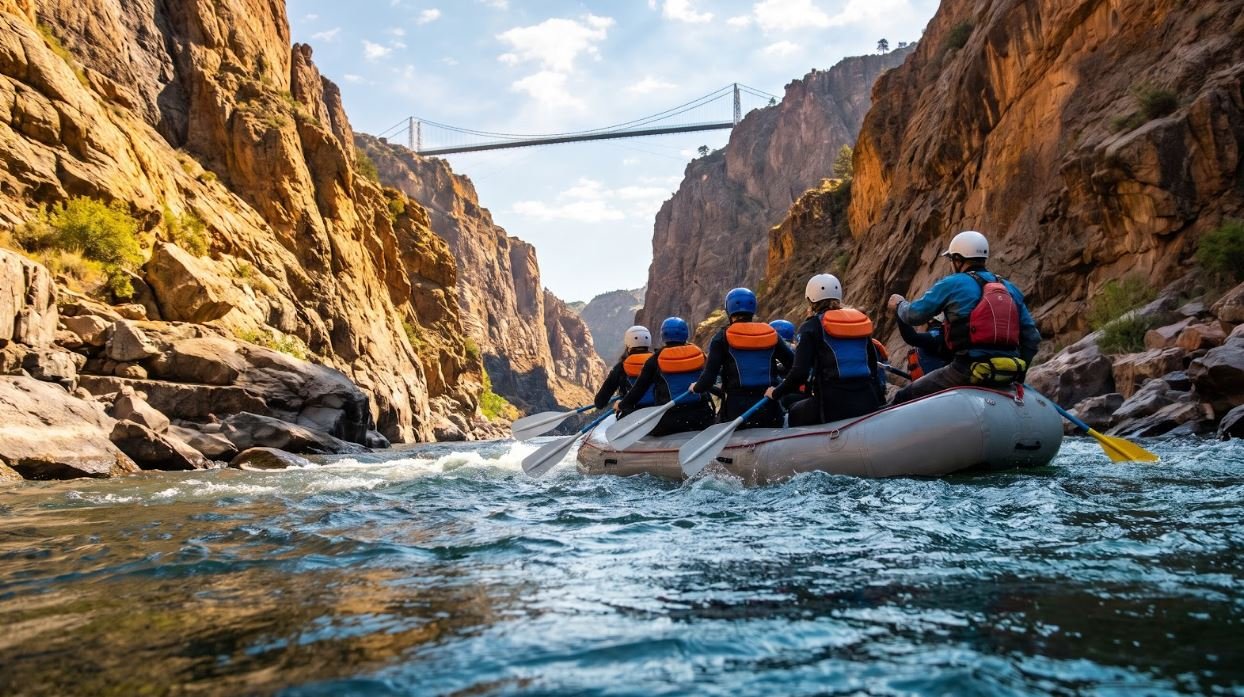
Yes, when today’s flow matches the plan. The Voluntary Flow Management Program (VFMP) aims for about 700 cfs at the Wellsville gauge from July 1 to August 15. After that, releases taper instead of stopping; native runoff continues; late-summer storms can still spike the river. Outfitters therefore run trips through Labor Day and, in healthy water years, into mid-September.
What matters on trip morning is the Parkdale gauge, which measures the Royal Gorge itself. Run this four-point check:
- Current Parkdale cfs and 24-hour trend
- CPW advisory status (high-water caution above 3,200 cfs)
- Afternoon weather outlook
- Outfitter confirmation: “Are you rafting the Gorge today, or reallocating guests?”
A falling river narrows channels and exposes sharp rock; a rising one adds speed and splash. Cañon City-based Echo Canyon River Expeditions, for example, runs its season from mid-April to mid-September, and its Royal Gorge trip length and minimum age vary with water levels. Ask your outfitter how it handles a low-water day before you book.
Bottom line: August 15 is a management milestone, not a shut-off valve. Stay gauge-savvy, heed advisories, and you can still punch Sunshine Falls long after back-to-school bells ring.
Royal Gorge at a glance: why this run feels so different
Picture a 10-mile hallway of polished granite, its walls rising about 1,000 feet above the Arkansas River. Echo Canyon rates the stretch primarily Class IV, with some rapids reaching Class V at peak flows, and once you leave Parkdale there is no practical trail to hike out. Scouting is tough, portaging nearly impossible, so licensed outfitters treat every launch as a firm commitment rather than a casual float.
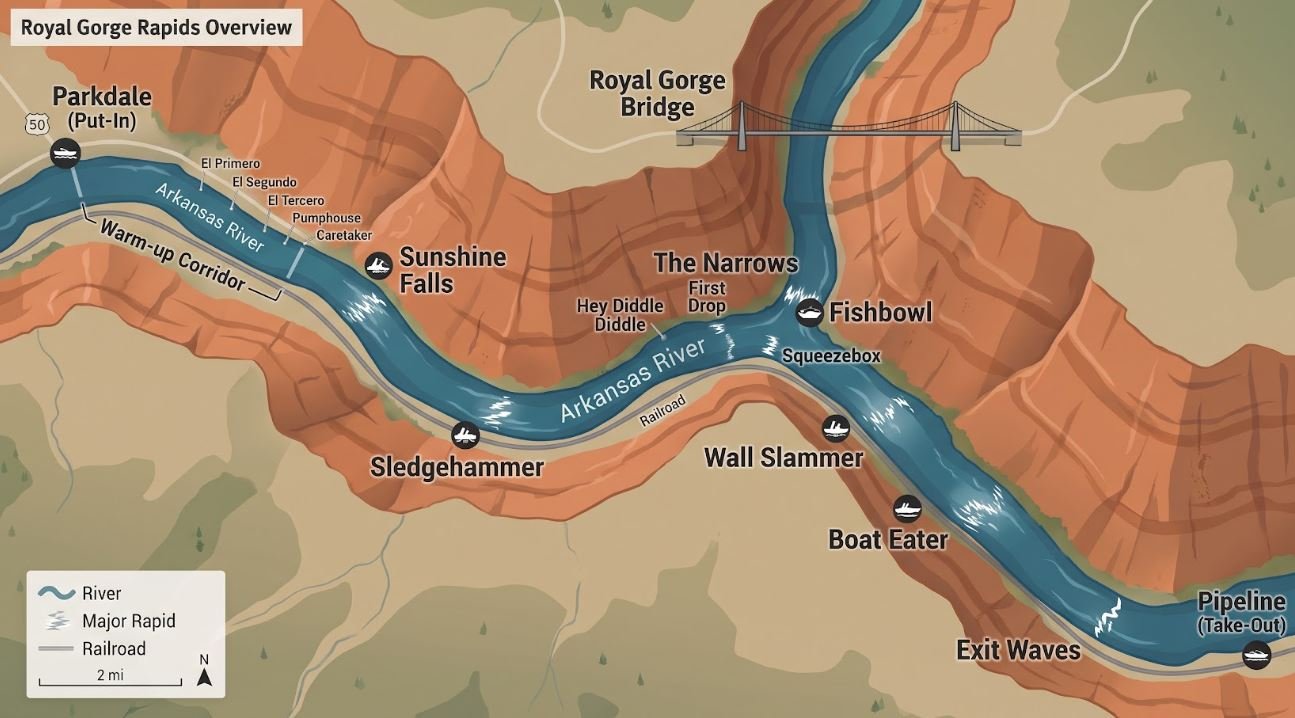
Before we size up individual rapids, get familiar with their names and personalities. A quick read through the best-known Royal Gorge rapids—Sunshine Falls, Sledgehammer, Boat Eater—gives you a mental map long before paddles touch water; that knowledge helps you follow commands the instant they matter.
An active railroad hugs the left bank while sheer rock hems in the right, narrowing sightlines and echoing every shout. High overhead, the Royal Gorge Bridge spans the canyon about 955 feet above the river, a stark reminder that you are rafting inside one of North America’s deepest granite gorges. From the warm-up riffles to the shadow under the bridge, the river offers only brief breathers, so outfitters favor morning departures when crews are fresh, focused, and ready for the technical dance ahead.
The river shrinks, the skill curve stays high
Think of early June: booming hydraulics and head-high standing waves. By late August the Parkdale gauge often falls to half that volume or less, yet the canyon keeps every twist of bedrock. Some holes mellow, but new ledges appear, channels pinch, and rafts skim closer to sharp rock. Lower numbers don’t make the Gorge easier; they swap brute force for surgical precision.
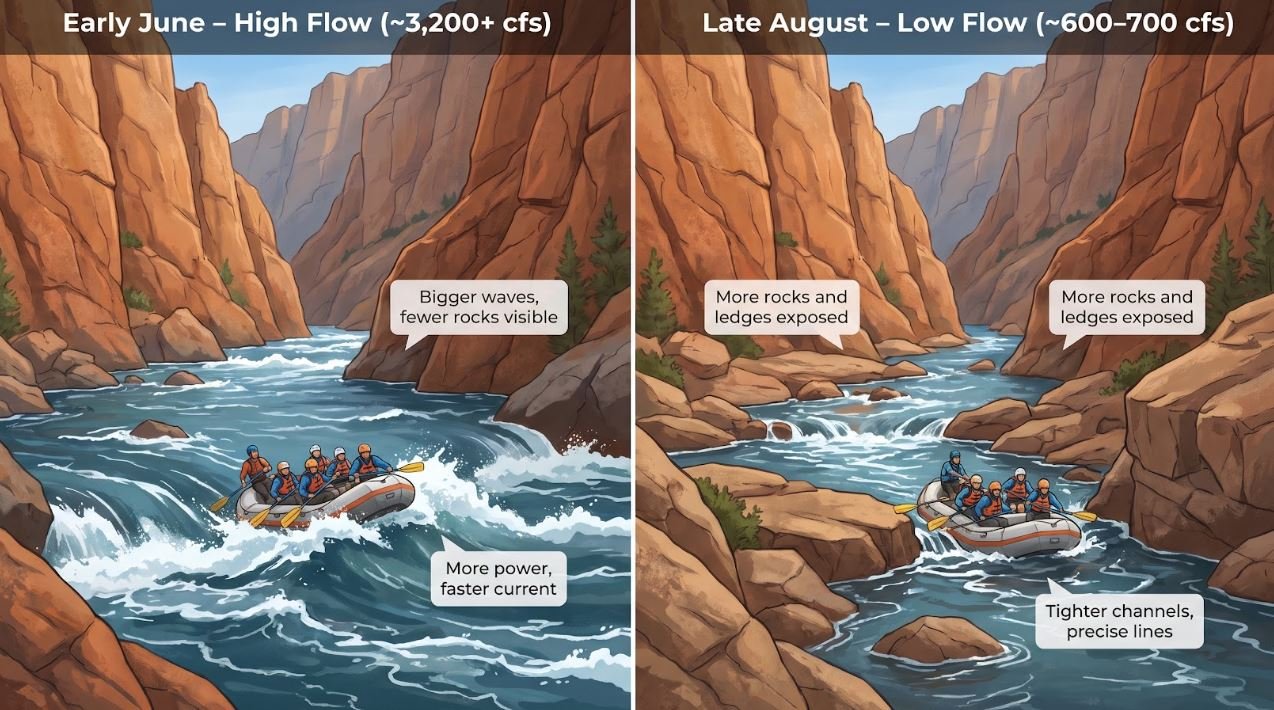
That shift is when teamwork matters most. With less current to hide a sloppy stroke, crews must snap to every command—forward two, back one, hard left. Miss one beat and the boat may stall, spin, or perch on a hidden shelf. Guides call this late-summer dance “threading the zipper”: slower pace, tighter seams, constant finesse.
By late September, the Parkdale gauge can read around 400 cfs, while peak runoff can exceed 3,200 cfs, according to the U.S. Geological Survey’s Parkdale station (07094500). That spread shows why live data, not last year’s memory, should steer your morning plan.
Weather slows, crowds thin
Cañon City’s late-summer weather feels kinder than spring runoff. Average highs reach about 86 °F (30 °C) in August and 80 °F (27 °C) in September, while cool dawn air makes a light fleece welcome on the shuttle. Afternoon thunderstorms can bubble up, so guides favor morning launches when skies and winds are steadier.
The human forecast shifts even more. The Arkansas Headwaters Recreation Area sees more than 1.4 million visitors a year, yet September draws only a fraction of that traffic. Fewer buses at the put-in mean quicker gear checks, quieter eddies, and photos free of strangers.
Shoulder season carries trade-offs. Some outfitters drop to long-weekend schedules, and a few wrap up for the year. Restaurants and hotels shorten hours. Confirm departure times and dinner plans ahead, and you’ll sidestep the summer rush while the canyon still hums with moving water.
The warm-up corridor
Rafts shove off at Parkdale, where the canyon still feels wide and forgiving. Guides use the milder water at the start to drill commands. “Forward two!” Paddles dig, spray flies, laughter follows, and crews settle into rhythm.
These first riffles let paddlers sync strokes and practice lean-ins with low stakes. Guides treat them as rehearsal: nail the angles here, they say, because Sunshine Falls is the first big rapid, and Sunshine never grades on a curve.
By the time the canyon walls close in, muscles feel warm, breathing is steady, and grins are wide. The technical dance is about to begin in earnest.
The first major test
Echo Canyon River Expeditions ranks Sunshine Falls among the signature Royal Gorge rafting rapids, calling out its twin five-foot drops that can elevate the run from Class IV to Class V when flows surge.
Sunshine Falls shows itself with a sharp horizon and a rising roar. Guides square the raft on a narrow tongue that drops, folds, then punches right and left. At peak runoff the exit hole can swallow a boat; by late summer it turns into a staircase of ledges that demands pinpoint angles. Miss a stroke and the raft may stall or pin broadside on exposed granite. Nail it, and the crew whoops into the pool below, hearts racing.
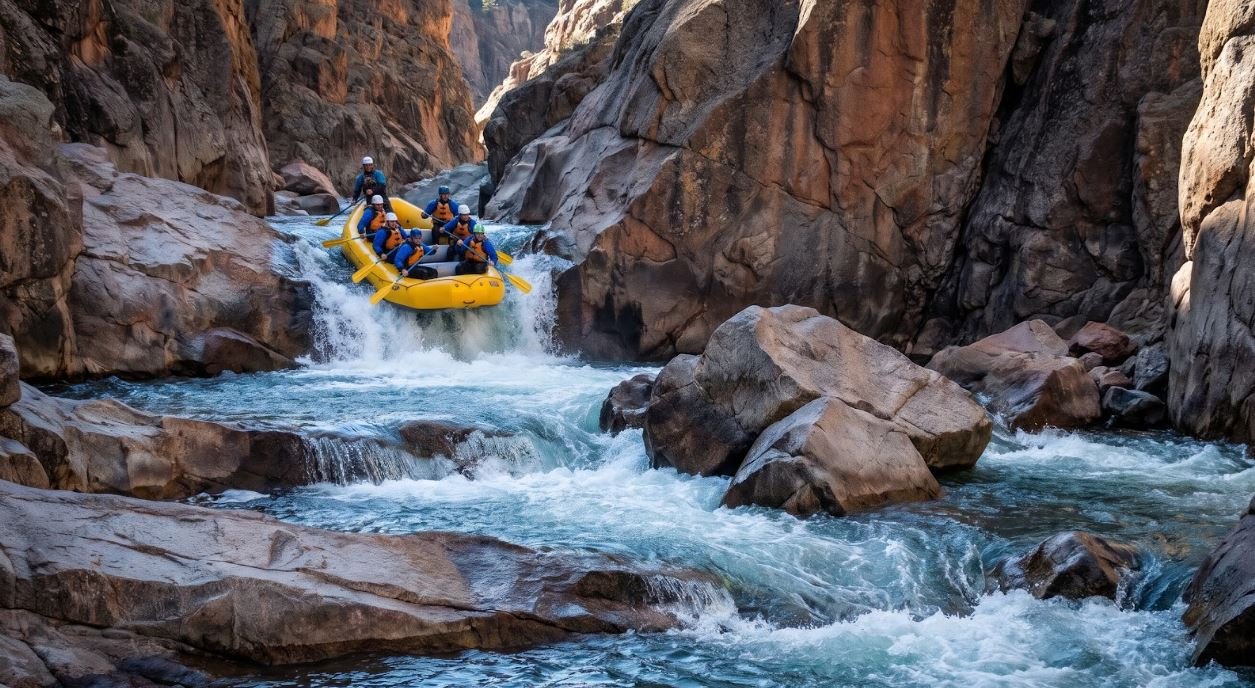
The calm is brief. Next up is Sledgehammer, another Class IV rapid that can reach Class V at peak flow. It starts with a slide into the big wave known as Sledge Hole, then drops over Bird Drop, an eight-foot plunge that ranks among the steepest in the Gorge, and finishes at the Envelope, two waves that fold together like an envelope seal.
The narrows
Here the canyon pinches so tight that the river channel spans only a few raft-lengths, about 20 feet in places. Water accelerates with nowhere to bleed energy.
The Narrows packs three back-to-back drops into the deepest reach of the chasm. First Drop, nicknamed Welcome Mat, demands full power. The bow lifts, slaps down, and surges into echoing granite. Recovery time is zero as Second Drop funnels straight into Squeezebox, a slot so narrow you could touch both walls if you dared stop paddling.
Finally, Third Drop spills into the Fishbowl, a fleeting eddy where crews glance skyward at the Royal Gorge Bridge far overhead. The hush ends fast: Wall Slammer waits around the bend, ready to prove the Narrows are only the opening act.
Beneath the bridge
The Royal Gorge Bridge hangs about 955 feet above the water here, and the roar of Wall Slammer drowns out everything else. This Class IV rapid pushes rafts close to a rock wall roughly 1,000 feet tall, and a tricky wave called the Vortex tries to pull boats straight into the cliff. Guides shout “Hard forward!” and paddlers dig to hold the line.
Boat Eater comes next. At higher water a big hole and wave form here, the “boat-eater” of the name. At late-season flows it turns into a technical, slower Class IV rapid with must-make moves and a couple of rock slides: power too late and you stall; over-correct and you brush the rock.
Nail both moves and the raft slides into calmer water, shoulders burning, adrenaline high. One rapid cluster remains, yet the canyon’s spiciest course is already recorded in memory.
The finishing sequence
Downstream of Boat Eater the river relaxes, but class lessons continue. A run of wave trains finally feels playful after the hammer blows upstream, inviting high-five paddle taps and wide-angle photos. Even in late season these waves pack enough punch to rattle loose smiles, so everyone stays low, knees braced, laughing each time the bow bursts through spray.
Then the gradient eases, the roar fades, and the raft glides into sunshine. Helmets come off, shoulders drop, and the crew cheers in equal parts relief and pride. The shuttle isn’t far, yet most groups linger, savoring the quiet-water epilogue of a canyon that never hands out easy victories.
Is a late-season Royal Gorge trip right for you?
The Gorge’s September personality is unapologetically advanced. It rewards paddlers who lean forward, punch through waves, and laugh after a surprise swim. If that sounds like you—or your active teenager—read on.
Pause, though, if anyone dreads deep water, is nursing a fresh injury, or hopes to film a five-year-old from the bow. This stretch demands commitment, quick reflexes, and confident swimming. Most families with younger kids head for the gentler upstream option.
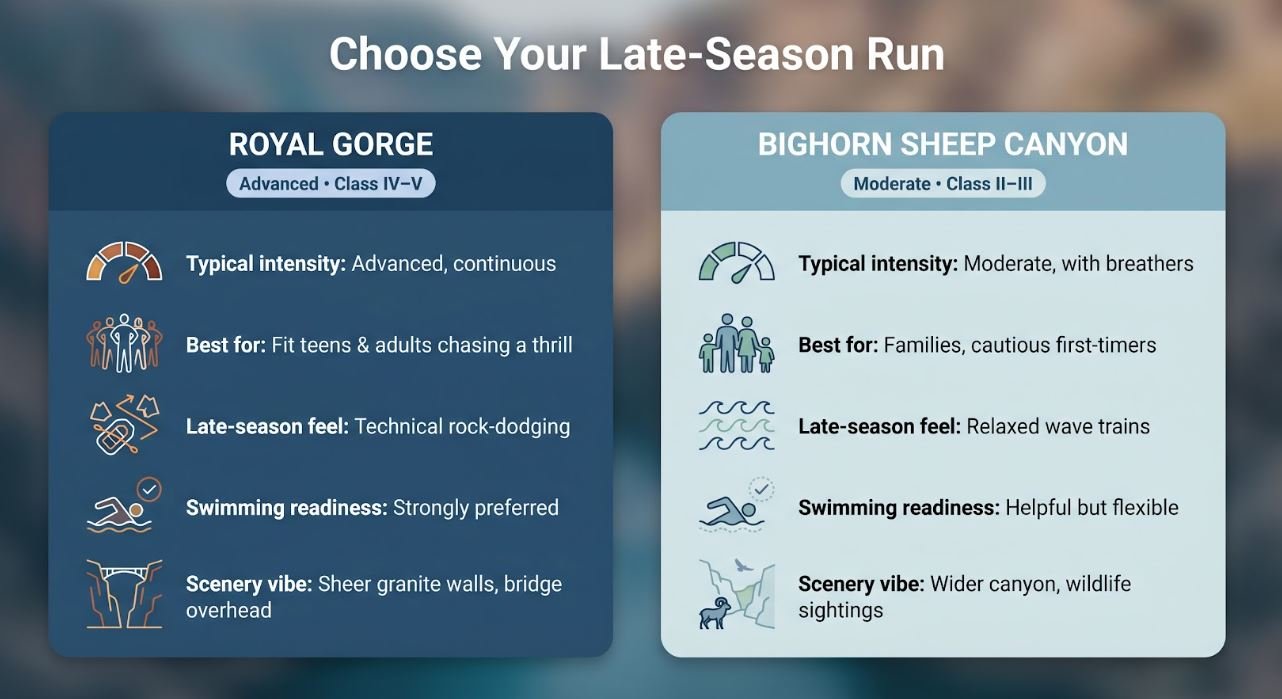
| Factor | Royal Gorge* | Bighorn Sheep Canyon* |
| Typical intensity | Advanced, continuous | Moderate, with breathers |
| Class rating | III–V (varies with flow) | II–III |
| Best for | Fit teens & adults chasing a thrill | Families, cautious first-timers |
| Late-season feel | Technical rock-dodging | Relaxed wave trains |
| Swimming readiness | Strongly preferred | Helpful but flexible |
| Scenery vibe | Sheer granite walls, bridge overhead | Wider canyon, wildlife sightings |
*Class ranges as published by Echo Canyon River Expeditions; ratings change with flow.
Pick the column that fits your comfort zone, book a morning launch, layer up for a cool shuttle ride, and paddle with purpose. The river rewards good preparation.
Safety, guide standards, and Colorado rules
Colorado treats the Royal Gorge as advanced terrain, and so should you. State law requires every commercial guide to be at least 18 years old, hold current first-aid and CPR cards, and log at least 50 on-river training hours; trip leaders need even more experience. Top outfitters add swift-water rescue courses, live drills, and veteran mentoring before a guide can call commands from the stern.
Equipment rules are just as firm. Every passenger wears a U.S. Coast Guard-approved life jacket for the whole trip, and helmets snap on once the raft leaves Parkdale beach. Early-fall mornings often call for wetsuits or splash tops (most operators include or rent them). Closed-toe shoes beat sandals, and that cotton hoodie can wait until après-raft photos.
Flow sets policy. Colorado Parks & Wildlife posts a high-water advisory for the Gorge at roughly 3,200 cfs on the Parkdale gauge. When levels climb that high, operators may raise age limits, shift guests upstream, or cancel. Low water brings its own hazards, such as pinning rocks and longer swimmer exposure. Ask three questions before launch:
- What’s today’s Parkdale reading and trend?
- Are safety kayaks or rescue rafts on duty?
- What happens if weather forces a mid-day change?
Choose a licensed outfitter, follow the briefing, and treat the Gorge with the respect it deserves. Precision and preparation turn a technical run into a memory, not a rescue drill.
How to book a late-season trip without guesswork
- Open with one question: “Are you running the Royal Gorge on my date?” If an outfitter hesitates or redirects, treat that as a yellow flag; conditions or staffing may already be marginal.
- Pick a morning launch. Departures around 8–9 am enjoy steadier water and a lower risk of afternoon storms. Cooler air also makes a wetsuit feel welcome, and an early finish frees your afternoon for a hot shower or the Royal Gorge dinner train.
- Half-day vs. full-day.
- Half-day: about 2–3 hours on water; covers every marquee rapid and fits a luxury weekend.
- Full-day: adds upstream miles and a riverside lunch but can stretch past 6 hours total when low water slows the boat. Ask whether the clock starts at check-in or at the riverbank; one detail can reshape your itinerary.
- Compare the full package, not just the price. Verify:
- Wetsuit or splash-top inclusion
- PFD and helmet quality
- Park or access fees
- On-river photography
- Shuttle distance and timing
- Guide-gratuity expectations
- Cancellation or rain-check terms
- Check the Parkdale gauge yourself the night before and again at breakfast. View real-time data on the USGS site (station 07094500) or through links many outfitters include in confirmation emails. A steady or rising river is a green light; a sharp overnight drop may move your crew to Bighorn Sheep Canyon or to a rain-check. When unsure, call the outfitter, ask for today’s cfs, and let data steer the plan.
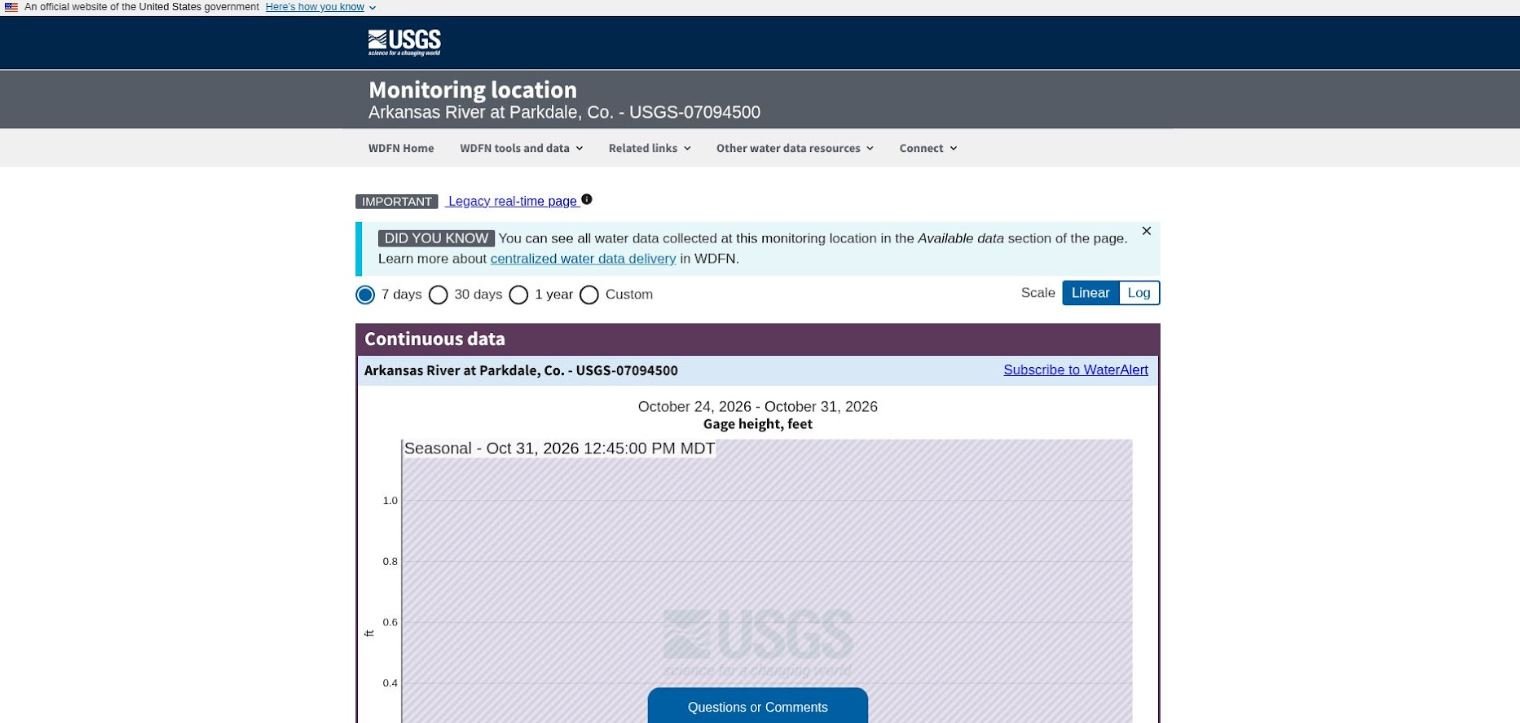
USGS Parkdale Gauge Real-Time Flow Page Screenshot
What to wear and pack
Think athletic, quick-drying, and secure.
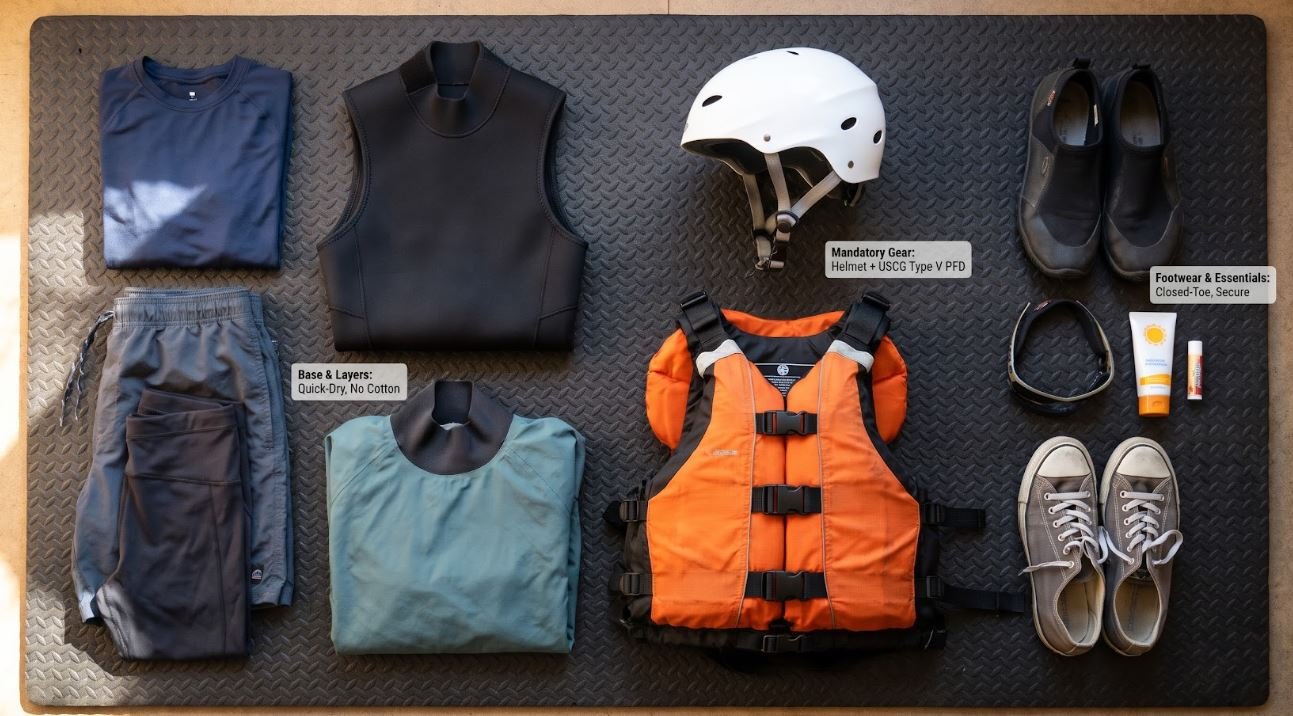
- Base layer: swimsuit or synthetic top that sheds water fast; skip cotton because it chills you and never dries in canyon shade.
- Legs: board shorts or compression leggings that stay put if you swim.
- Footwear: closed-toe river shoes or old sneakers that lace tight; flip-flops and Crocs vanish in the first hole.
- Thermal layer: guides issue wetsuits or splash tops when dawn temps drop below 60 °F (16 °C).
- Mandatory gear: helmet and USCG-approved PFD, both supplied and fitted by your outfitter.
Stash sunscreen, lip balm, and sunglasses with a stout retainer in a secure pocket. Everything else—towel, dry clothes, phone—rides the shuttle and greets you at take-out. Leave jewelry and loose caps behind; freedom of movement beats fashion points when the camera shutter clicks.
Turn the rafting trip into a luxury-adventure weekend
Stay
- Hotel St. Cloud, Cañon City: a restored 1880s landmark two blocks from cafés and galleries.
- Royal Gorge Cabins: on US-50 west of Cañon City, at Echo Canyon’s rafting base, where cedar-scented decks frame the canyon you conquered that morning. Either base lets you swap river grit for cocktail chic in under ten minutes.
Dine and glide
Evening trades paddles for crystal stemware on the Royal Gorge Route Railroad. First-class tables roll past the very rapids you surfed hours earlier, now glowing gold beneath bridge shadows. Order the bison short rib, raise a toast to teamwork, and let the sommelier handle pairings.
Slow-motion day three
- Tunnel Drive (3-mile round trip) captures sunrise on canyon walls.
- Skyline Drive (one-way, 2.6-mile ridge) delivers dinosaur tracks and 360-degree selfies without the altitude headache.
- Cap the morning with a spa session or high tea at The Broadmoor in Colorado Springs, about a one-hour drive, before your flight home.
Adventure, refinement, and breathing room all fit inside 36 hours. This itinerary proves you can spike your pulse and pamper it on the same weekend, with zero compromise required.
Frequently asked questions
Can I raft the Royal Gorge after August 15?
Yes, flows often remain runnable into September. Managers stop targeting about 700 cfs at the Wellsville gauge on August 15, but native runoff, storms, and gradual dam releases keep water moving. Check the Parkdale gauge (USGS 07094500) the morning of your trip and confirm with a licensed outfitter.
Is lower water easier?
Not really. Smaller waves can expose pinning rocks and demand sharper paddle work; guides call late-season runs “surgical” for a reason.
What cfs is best?
Many outfitters like 600–1,200 cfs for a balance of punch and precision, while CPW posts a high-water advisory above about 3,200 cfs. Weigh today’s reading, recent trend, and guide input as one package.
Do I need prior rafting experience?
Solid fitness and fast listening beat a résumé of river trips. Some companies welcome adventurous first-timers; others prefer you have Class III practice. Be honest about your comfort in moving water.
What is the minimum age?
Policies flex with flow. Expect 13+ years at normal levels and 15–16 years when water rises. Operators can tighten limits overnight after storms or snowmelt.
Must I know how to swim?
Strong swimming is highly recommended. You’ll wear a Type V PFD, but self-rescue confidence shortens time in the water if you fall out.
How long does a late-season trip take?
Half-day runs average 1.5–2 hours on water in spring; at around 500 cfs they can stretch past 2.5 hours as guides pick precise lines. Build slack into afternoon plans.
What happens if flows drop too low or spike too high?
Outfitters may move you to Bighorn Sheep Canyon, reschedule, or issue a refund—ask about policies before you book.
Is a guide legally required?
Private experts may run the section under state boating rules, but for visitors the smart move is a licensed commercial guide with safety support.
How far is the Gorge from Colorado Springs and Denver?
Cañon City sits about 45 mi (72 km), roughly 1 hour, from Colorado Springs via US-50. Denver drivers should budget about 120 mi (2 hours) plus wiggle room for I-25 traffic and canyon construction.
Conclusion
Late summer swaps brute force for finesse. Lower flows sharpen every rapid, thin crowds, and open more options for comfort after the take-out. Check the Parkdale gauge, book a licensed guide, and bring a crew that values precision over splash bragging rights. Pair the morning rush with luxury touches such as a boutique suite, first-class dinner train, or spa soak, and you’ll leave Colorado carrying both adrenaline and serenity in the same weekend bag. The season doesn’t end on August 15; the Royal Gorge simply changes tempo until outfitters close for the year in mid-September.