
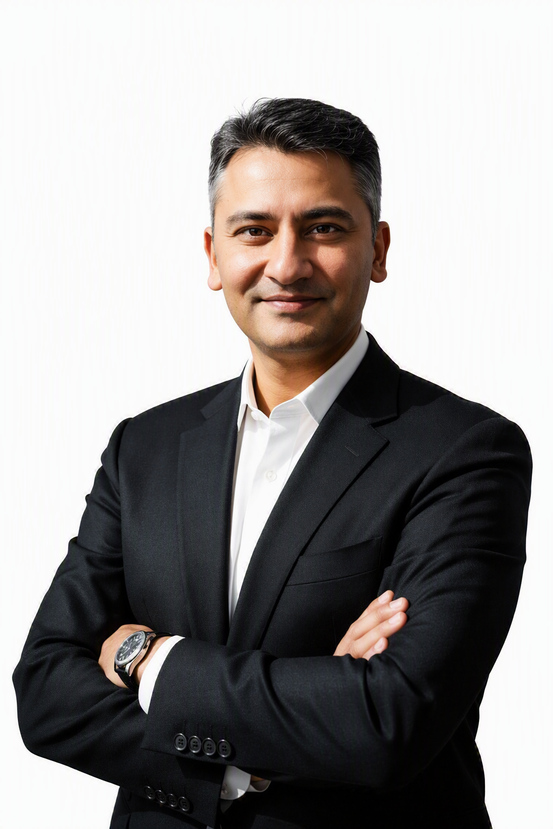
Every successful business leader has a story filled with challenges, bold decisions, lifelong learning, and moments that redefine both careers and lives. Dr. Aakash Dil is one of those inspiring leaders whose remarkable journey combines academic excellence with practical executive leadership. From navigating complex financial markets to researching artificial intelligence, leadership, risk management, and human decision-making, he has dedicated his career to helping organizations and individuals make smarter, more confident choices. His passion for sharing knowledge through books, research, speaking engagements, and TEDx presentations continues to inspire professionals around the world.
In this exclusive Business Leaders feature, we explore the experiences, philosophies, and lessons that have shaped Dr. Dil’s impressive career. He shares valuable insights into leadership, resilience, innovation, financial literacy, and preparing for the rapidly changing future of business. Whether you’re an entrepreneur, executive, student, or aspiring leader, his perspectives offer practical guidance that can help you grow both professionally and personally.
WATCH PODCAST EPISODE NOW
Banking, Risk Management and the Power of Continuous Learning
Beverly Hills Magazine: Good morning. It is such an honor to have you with us today.
Dr. Aakash Dil: Thank you. It is my pleasure. I am delighted to be here.
Beverly Hills Magazine: Let us dive right in. What inspired your journey and career in banking and risk management?
Dr. Aakash Dil: My journey spans around 19 and a half years, and it has been shaped by a fascination with decision-making and problem-solving. From an early stage, I was drawn to mathematics and number crunching because it provided clarity in a world full of uncertainty.
Banking gave me an opportunity to apply analytical and critical thinking to real-world challenges. Risk management allowed me to understand how organizations can grow sustainably while navigating uncertainty.
What excites me today is that risk management is no longer just about protection. It has become a strategic driver of business success.
Beverly Hills Magazine: I love that you have a mathematical mind. I am fascinated by that because I believe it is a gift from God. Not everybody has that ability, but when you have a mind like that, it becomes an incredible skill and gift.
What motivated you to pursue multiple doctorates and advanced qualifications?
Dr. Aakash Dil: When I started my career in 2006, there was limited knowledge related to mathematics, actuarial science, and financial risk management. For me, learning has never been a destination.
Every qualification represented an opportunity to deepen my understanding and broaden my perspective. As industries evolve year by year, especially in finance and technology, staying relevant requires continuous development.
My academic journey reflects my belief that curiosity should never have an expiration date.
Whenever there was a new element of my profession, I felt that I should learn it. I completed my first Master of Business Administration degree in 2005, and over the last 21 years, things have changed dramatically. That is why I have always wanted to remain relevant within the industry.
Beverly Hills Magazine: Absolutely. We are eternal students of life. We should always be expanding our minds and continuing our search for knowledge, especially in our careers.
Dr. Aakash Dil: That is true. I also teach, and the questions I received from students ten years ago are very different from the questions I receive today. There is a vast difference in the maturity of those questions.
You have to keep yourself abreast of new knowledge, new fields, and new terminology so that you can answer questions in a relevant manner.
Capital Management and Navigating Economic Uncertainty
Beverly Hills Magazine: You are the head of market risk and capital management at a major bank in the United Arab Emirates. How do you balance regulatory capital requirements with the strategic objectives of the bank while maintaining long-term profitability?
Dr. Aakash Dil: I view capital not simply as a regulatory requirement. It is not just about maintaining a certain percentage for the Central Bank of the United Arab Emirates or meeting international banking standards. Capital is a strategic asset.
Effective capital management enables a bank to remain resilient during periods of stress while supporting growth initiatives during favorable conditions.
The objective is to align capital allocation with both regulatory expectations and long-term business strategy.
There is a very thin line, so you have to create an equilibrium. You have to change your variables using macroeconomic and microeconomic variables and then derive new strategies when required.
For example, economic conditions can change rapidly across the Gulf Cooperation Council region and beyond. A budget and strategy developed in January may no longer be relevant several months later. We have to adjust according to economic expectations.
Beverly Hills Magazine: In your opinion, what is the current economic landscape like? Would you describe the market as volatile or stable?
Dr. Aakash Dil: If I frame your question properly, you are asking how we determine whether stress should be treated as part of our current business-as-usual environment and how we design scenarios around it.
Historical events provide valuable lessons, but they are not enough. We combine historical analysis with hypothetical scenarios.
We ask questions such as: What happened in February this year? What if something similar happened again this month? What happened in 2020 during the coronavirus disease 2019 pandemic? What if a similar situation occurred today?
We create hypothetical scenarios that challenge assumptions and explore extreme but plausible outcomes.
Beverly Hills Magazine: So the goal is not necessarily to predict the future, but to prepare for multiple possibilities?
Dr. Aakash Dil: Exactly. We do not know whether something that happened in the last five years, three months ago, or four months ago could happen again.
We also consider events occurring in other countries, including countries experiencing war. We ask, “What if something similar happens here? How will we manage our assets?”
We source variables from research organizations. However, when a third-party research organization completes a major study, it may take three or four months. By the time the research is concluded, something may already have changed in the region.
Therefore, we use management overlays. We apply hypothetical overlays based on historical events that have already happened.
For example, we may examine how severely the market could decline if a situation similar to the coronavirus disease 2019 pandemic occurred, particularly if foreign exchange markets became less liquid than they are today.
Beverly Hills Magazine: What percentage of reliability would you place on these projections? There are always unknown variables and unforeseen circumstances.
Dr. Aakash Dil: I would say that when you are doing scenario analysis, it should be good enough. Good enough is fine.
You cannot predict the perfect outcome or the exact outcome because there is questionable and incomplete information. You cannot develop a perfect model.
You need a model that gives you a reasonable understanding of where the market may be going, how your peers are performing, how they are generating profits, and how you can leverage certain strategies.
That is good enough.
Beverly Hills Magazine: So it is about making decisions and taking action based on confidence rather than certainty?
Dr. Aakash Dil: Absolutely.
Numbers, Human Intelligence and Intuition
Beverly Hills Magazine: I am a Christian, so I often look at these subjects through a Christian paradigm. I believe that God can reveal things about the future and provide insight into decision-making. Sometimes we may receive an intuitive or spiritual sense about whether an outcome will be positive or negative. How do you view that relationship between models, data, experience, and human judgment?
Dr. Aakash Dil: Models are powerful tools, but they are not substitutes for experience and critical thinking.
My philosophy is to respect the numbers, but never become dependent on them.
Effective risk management requires combining quantitative rigor with qualitative judgment.
Beverly Hills Magazine: I agree. Intuition can also play a role in guiding decision-making, particularly when it is combined with experience and discernment.
Dr. Aakash Dil: Absolutely.
Artificial Intelligence and the Future of Risk Management
Beverly Hills Magazine: How has the integration of artificial intelligence, machine learning, and advanced analytics changed the way market risk is identified, measured, and managed today?
Dr. Aakash Dil: Artificial intelligence is improving efficiency, enhancing analytics, and enabling better decision-making.
It gives us the ability to process enormous amounts of data in real time.
At the end of the day, artificial intelligence relies on what it has been trained and tested on. Artificial intelligence models work by creating routines and feeding them test and training data so that the model can understand the objective.
Those test and training datasets are often based on simulations and historical information.
Artificial intelligence helps enhance our capabilities, but I believe that creating something new and bringing a new perspective still requires human intelligence and critical thinking.
Beverly Hills Magazine: Absolutely. I think many people make the mistake of relying on artificial intelligence as though it were an oracle. It is not. It is an information and data-analysis tool.
Dr. Aakash Dil: That is correct.
Organizations should also pay close attention to governance, ethics, data quality, privacy, and transparency. Technology should enhance trust, not undermine it.
That is a principle I regularly discuss with my head of information security.
Beverly Hills Magazine: Since the beginning of time, ethics have been an integral part of human behavior, whether in business, relationships, or everyday life. We always have to maintain ethical standards in whatever tools we use.
Dr. Aakash Dil: Yes.
The Future of Risk Management
Beverly Hills Magazine: Looking ahead, what do you believe will distinguish the world’s leading risk and capital management professionals as financial markets become increasingly interconnected, technology-driven, and complex?
Dr. Aakash Dil: First, everyone should understand that risk management is not solely the responsibility of risk management professionals within an organization.
Risk identification is everybody’s responsibility.
If a business unit brings in a new customer, for example, that team should understand the associated risks.
With advancements in technology, new concepts, and changes in business paradigms, everyone within an organization should understand emerging risks.
Always remember that risk identification is more important than risk management.
If you have not identified the risk and you are simply preparing yourself to manage it, what exactly are you preparing for?
Once you identify the risk, you can communicate it to others so they can learn from it. That is how growth occurs throughout an organization.
Beverly Hills Magazine: I love that. There is a saying that “forewarned is forearmed.” If you identify potential risks, you can prepare to avoid the consequences if they materialize.
Dr. Aakash Dil: I actually gave a full TEDx talk on this subject, focusing on risk management and uncertainty.
We often become worried about risks because we immediately think about the impact and the final result. But first, identify whether it is actually a risk.
Sometimes the shadow under the bed is just a shadow. It is not a ghost.
We often fear that there is something there when it may simply be a shadow.
Fear, Risk and Opportunity
Beverly Hills Magazine: I love that. I want to explore the subject of fear because many people are driven by fear, both in life and in business.
Is this informed fear? Is it critical-thinking fear? Is it irrational fear? Is there such a thing as healthy fear?
Dr. Aakash Dil: Fear can be healthy.
If you have a fear of your parents, your teacher, or what might happen in the market, that fear can indicate that you recognize the possibility of another event occurring.
The important thing is to understand the fear.
Risk is not something to fear. It is something to understand.
Every opportunity in life carries some degree of risk, and success often depends on managing that risk intelligently.
Beverly Hills Magazine: I love that. There can be no risk without the possibility of reward. Starting a business or taking a leap of faith involves risk, but understanding those risks allows you to make informed decisions.
Dr. Aakash Dil: Exactly.
The biggest misconception about risk management is that it is something to avoid.
In reality, it is about taking the right risks so that we can measure them and inform senior management in a decisive manner.
Leadership Is a Responsibility
Beverly Hills Magazine: Let us talk about leadership in business. What does great leadership mean to you?
Dr. Aakash Dil: That is an interesting question.
First, I would say it depends on the situation.
Great leadership, according to me, is about creating an environment where people can perform at their highest potential.
It is about trust, accountability, and empowering others to succeed.
Leadership is not a position. Leadership is a responsibility.
Earlier in my career, I focused heavily on execution and results. Over time, however, I realized that sustainable results come through people.
Today, I spend more time coaching, mentoring, and developing talent than I did at the beginning of my leadership journey.
Beverly Hills Magazine: I love that. How do leaders like yourself build trust during uncertain times, particularly when people around them may be operating from fear?
Dr. Aakash Dil: Trust is built through consistency, transparency, and authenticity.
During uncertainty, people do not expect leaders to have every answer. They expect honesty, clarity, and confidence in navigating challenges.
Beverly Hills Magazine: What leadership mistakes do you see most often, and what would you caution other leaders not to do?
Dr. Aakash Dil: One common mistake is focusing excessively on processes while neglecting people.
Another is believing leadership is about authority rather than influence.
The strongest leaders listen as much as they speak.
Beverly Hills Magazine: Absolutely. There was a post I saw on LinkedIn that said, “A boss says, ‘Do it.’ A leader says, ‘Let’s do it.'”
That is a powerful distinction.
Dr. Aakash Dil: It is, and it carries very deep meaning.
Decision-Making and Taking Action
Beverly Hills Magazine: Let us shift into decision-making. Leaders carry significant decision-making responsibilities, but people in every role within an organization must make decisions.
Why do people struggle with making important decisions?
Dr. Aakash Dil: People often seek certainty in situations where certainty does not exist.
Fear of failure can create paralysis.
The key is understanding that making a good decision is often more important than making a perfect decision.
Start with something that is good enough.
Beverly Hills Magazine: Making a decision is often better than making no decision at all because at least there is initiative and action. You move forward instead of remaining stagnant or complacent.
Dr. Aakash Dil: Correct.
Confidence develops through action, not through waiting.
Every decision provides feedback and learning opportunities. The more decisions you make, the stronger your judgment becomes.
Beverly Hills Magazine: There is a saying that “what we build, builds us.” We have to take that leap of faith and move forward, knowing that we will grow and learn along the way.
Dr. Aakash Dil: Exactly.
Sometimes when you are busy, you may believe that being busy means you are productive.
But you have to ask yourself: Is what I am doing actually taking me forward?
If it is not taking you forward, perhaps you are simply keeping yourself busy because you are afraid to make a decision.
For example, someone may be afraid to leave a job and find another position that better uses their potential. They think, “If I leave this job, will I find another one?”
How will we know if we never take the risk?
Beverly Hills Magazine: That is so true. We have to take action and direct our lives by making assertive decisions that create change.
That is how we become effective in building businesses, growing organizations, and achieving success. Ultimately, our lives are shaped by the cumulative effect of our decisions.
My father always said, “If you do not like where you are in life, you have to make different decisions.”
Dr. Aakash Dil: Exactly. You have to start making decisions.
Intuition, Spirituality and Data
Beverly Hills Magazine: Can intuition, spirituality, and data analysis successfully work together? Is there a meeting ground between intuition and analytical decision-making?
Dr. Aakash Dil: Absolutely.
Data provides evidence, while intuition provides context.
The strongest decisions usually emerge when analytical insights and experience complement each other.
Beverly Hills Magazine: That is good to know. I believe there is tremendous value in allowing analytical reasoning and intuitive discernment to work together.
Artificial Intelligence and the Financial Industry
Beverly Hills Magazine: Let us return to artificial intelligence because it is such a major subject today. How is artificial intelligence transforming the financial industry, particularly banking?
Dr. Aakash Dil: Nowadays, we have vast amounts of data.
If we were trying to make an informed decision using all available data in its current form, we would not be able to comprehend the sheer volume.
The speed of data is different today. The currency and timing of data are also different. Data moves so quickly and exists in such vast quantities that you cannot comprehend everything manually.
Artificial intelligence provides the ability to process enormous amounts of data in real time.
For example, if you want to create a dashboard or a heat map, previously you might have used Microsoft Access as a database and Microsoft Excel on the front end.
Nowadays, you have Python and structured query language for relational database management systems. With Python, you can create sophisticated dashboards.
There are also many other tools available.
A few weeks ago, a friend of mine was working with a very powerful tool called Canva, which is widely used in media.
Beverly Hills Magazine: I use Canva. I love it.
Dr. Aakash Dil: It was beautiful. She was creating a curriculum vitae using Canva.
I still create mine using Microsoft Word.
Beverly Hills Magazine: Oh, no! Welcome to the world of Canva. It is an amazing creative tool.
Dr. Aakash Dil: It really is.
I thought it was so beautiful that I subscribed and started creating mind maps and transforming some of my presentations using Canva.
It is brilliant.
Beverly Hills Magazine: That is what I love about the artificial intelligence and technological revolution we are experiencing.
The creative efficiency and multiplication of ideas have improved so dramatically. I am having so much fun using all the tools available.
There is a saying that creativity is intelligence having fun. When we have tools that help us become more creative, it becomes incredibly exciting.
Dr. Aakash Dil: Absolutely correct.
Artificial intelligence is not only transforming finance. It is transforming virtually every industry.
Again, I will reiterate what I said earlier: the ability to process enormous amounts of data is extremely important.
If you can comprehend and control that volume of information, it can work in your favor.
If you do not know how to use it, it can become overwhelming.
I sometimes use the analogy of giving a machine gun to an ordinary person versus giving it to a trained sniper. An ordinary person may fire randomly, while a sniper knows exactly where to aim.
The same principle applies to data. You should have control over the enormous amount of information being produced and transformed through artificial intelligence.
The Human Skills That Matter Most
Beverly Hills Magazine: That leads perfectly into my next question. What skills will become most valuable in an artificial intelligence-driven future, particularly the human skills we will need as technology continues to advance?
Dr. Aakash Dil: Adaptability, critical thinking, emotional intelligence, communication, and continuous learning will become increasingly important in an artificial intelligence-driven economy.
If you cannot adapt, you will be left behind.
If you do not have critical-thinking skills, you may accept every answer that ChatGPT provides without questioning it.
I will give you an example.
Ask any question from ChatGPT and then write one simple sentence after receiving the response: “Are you sure this is 100 percent correct?”
Many times, ChatGPT will respond by acknowledging that it missed a reference or that the information is not current.
That is why you must apply critical thinking.
Do not simply accept responses from artificial intelligence.
If you are in a particular situation and receiving a response from artificial intelligence, use your emotional intelligence as well.
At the end of the day, you are working with human beings.
Conclusion
Dr. Aakash Dil demonstrates that lasting success is built through continuous learning, thoughtful leadership, and the willingness to embrace uncertainty rather than fear it. His unique combination of academic achievement, executive experience, and passion for helping others provides valuable lessons for anyone striving to make better decisions and lead with confidence. As technology continues to reshape industries and the pace of change accelerates, his practical approach to leadership, risk management, and personal growth offers a roadmap for navigating the future with clarity and purpose. His journey serves as a reminder that the greatest opportunities often begin with the courage to make one meaningful decision.