


Whether you’re a fellow business leader, an aspiring executive, or simply someone passionate about unlocking human potential, you’re in for an inspiring read.
Jim Carlough is a renowned leadership expert, known as The Leadership Identity Architect, with over 30 years of hands-on experience transforming teams, cultures, and executives—particularly in healthcare and high-growth environments. Mentored in legendary settings like Perot Systems, he has held C-suite roles (including tripling SaaS revenue as President of HealthTrio, now mPulse), turned around underperforming organizations, and built high-performance teams.
His core belief: Leaders aren’t born—they’re built through intentional identity development, not just skills training. The real issue isn’t a lack of competencies; it’s an identity gap where talented people don’t see themselves as leaders, leading to disengagement, turnover, and failed successions.
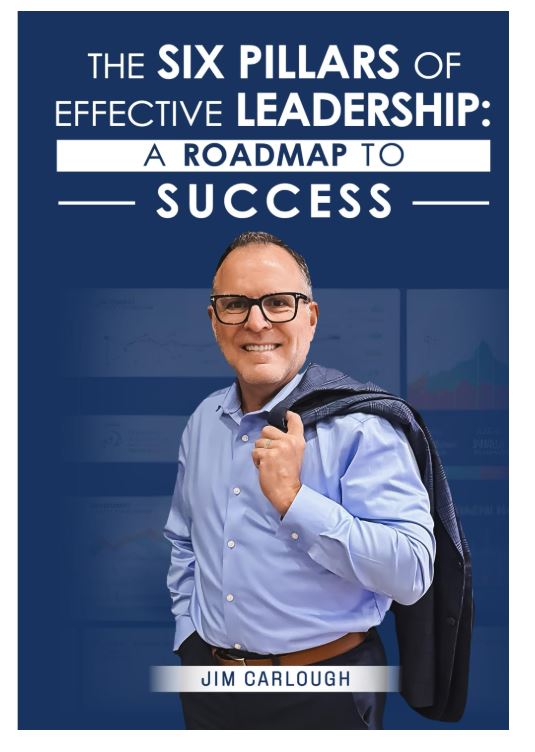
His bestselling book, The Six Pillars of Effective Leadership: A Roadmap to Success, offers a character-based framework focused on six irreplaceable human qualities—Integrity, Focus, Empathy, Compassion, Stability, and Humor—that AI can’t replicate, emphasizing inside-out growth for future-proof leadership.
Exclusive Interview with Jim Carlough
Beverly Hills Magazine: How are you, Jim? I’m so incredibly impressed with your book.
Jim Carlough: Well, thank you.
Beverly Hills Magazine: So let’s dive in. First, tell us what first drew you into the world of leadership development over 30 years ago?
Jim Carlough: So, well, actually, I’ve been a leader for 30 plus years. And during that time, I’ve done a lot of mentoring of other leaders. And a couple of years ago, I sat down and trying to decide in the next chapter of my life, what do I want to do? Because the next chapter will be retirement. And I know that if I don’t have something to do, my wife will give me a list of things to do every day. And that’s not going to work well.
Beverly Hills Magazine: Yeah, those aren’t the things you want to be doing necessarily. Lol.
Jim Carlough: Correct. And I’m terrible at golf, so I’m not going to play golf every day. And I thought, you know, I probably could speak on leadership. And so I started talking to people and developing this thought process of speaking about leadership and creating workshops. And then as I was doing that, I happened to talk to a speaker that’s in the million dollar category. And I said to him, I said, you know, how do you get credibility? And he said, well, you don’t need it. And I said, well, what do you mean you don’t need it? He said, look at your resume, your resume, your credibility. And I said, yeah, but I’m not going to hand out my resume to people and say, hey, let me come and help you. So I didn’t take his advice and I wrote a book. And there it is.
Beverly Hills Magazine: And there it is. Well, congratulations on the book. It is truly an incredible resource for effective leadership. I mean, it’s all in the title. Six Pillars of Effective Leadership, the Roadmap to Success. You know, just diving into it, it’s so comprehensive and there’s so much research and real life world leaders that exhibit these pillars, these characteristics, which we’re going to dive into that prove that they work.
And it has taken off. And it’s been an interesting journey, both good and bad. But it’s been a lot of fun. And just today, I launched a campaign on social media for an upcoming webinar that will introduce people to the workshops. So I’m ready. Yeah, I’m ready to roll those out.
Jim Carlough: Well, yeah, so you hit on the exact point. I wanted to have a book that was first implementable, easy to read. And that also said to people, look, don’t believe me. Look at these other leaders who use this characteristic as well. And what and their organizations that they ran or the countries that they ran or whatever they did. And so and at the end of the day, the last thing I wanted was I wanted if anyone had worked for me ever, if they picked up this book, I wanted them to think or feel that I was sitting next to them just having this conversation. And everyone that knows me who has purchased the book has said, I feel like he’s sitting in the room with me. In fact, I’ve had people post reviews that say the same thing. I feel like I have a wise mentor sitting next to me, giving me their 30 plus years of experience in a condensed way so I can become better.
Beverly Hills Magazine: Yeah, it’s a very personal read. I love it. So you’re called the Leadership Identity Architect. Tell us, what does that mean exactly?
Jim Carlough: So actually, a podcaster gave me that name. I have done a bunch of podcasts. In fact, I’ve paid for no advertising. Yeah. And my book has I mean, I for a first time author, I’ve sold over 5000 copies.
Beverly Hills Magazine: And you’re just getting started.
Jim Carlough: And I’m just getting started. And so I was on this podcast, and we’re talking about the shift from authoritarian leadership to more collaborative leadership as we’ve evolved from the 70s to 80s to 90s to where we are today. And we got into it. And I said, Well, really, it becomes an identity issue. And so the gentleman said to me, well, shouldn’t you be called the Leadership Identity Architect? And I said, Oh, perfect. I said, I love that. I’m going to steal it. He said, you have my permission to steal that. So from that point forward, I started calling myself the Leadership Identity Architect. And it all goes back to the way we behave in business, because what we do, and this is done in other countries as well. When we have an open position, we typically look for the best technical resource in that group, pull them out, and we make them what I call an accidental leader. They didn’t intend to be a leader, they were accidentally thrown into it, but not given a roadmap, and not given permission to lead, and really not given direction other than an assumption by leadership that they know what they need to manage. And what happens is, they don’t. And then they, you know, 18 months into it, their team starts to dissolve because they quit because they they’re confused.
The leaders burnt out, because what he’s doing is, he or she is doing the same things they did before in solving problems as opposed to leading and helping people learn to how to solve their own problems. And so it’s that whole concept of changing the focus of the person from being an individual contributor to actually being one of a coach and a leader is hard, and it’s got to be a deliberate thing. To me, the one myth I always hated hearing was, and I call this the biggest lie in business, that leaders are born that way. And that’s not true at all. Leadership has to be developed, and it evolves. As the world evolves, our leadership evolves, and the way we work with individuals evolves. And I think back to my first management job, I was horrible. I was horrible. I mean, I had a person come into my office, a woman who didn’t like a decision I had made, and started screaming. I mean, literally screaming. I found myself screaming back. I would never do that today. I would never do that today.
And so, you know, that evolution and that learning was deliberate. And I tell people, if you want to get into leadership, jump in. The water’s not cold, but it’s a never-ending process. And the other thing I ask, I like to ask people is, when does leadership begin every day? Does it begin when you get to the office? And my answer is no. It begins when your feet hit the floor and you get out of bed. Because from that moment on, you have the ability to interface with someone, even in your family, and make an impact.
Beverly Hills Magazine: That’s beautiful, because that’s where the identity shift takes place, because now you’re a leader in your everyday being with whoever you’re interacting with. And this allows you to be more effective in your business, in your marriage, in your familial relationships. It’s so vital. And I like, it’s school of life. We are on an evolutionary journey of self-development and self-growth. And so, these characteristics, which we’re about to dive into, are vital not only in business, but what I love about your book is that it’s teaching leadership in how to be intentional with these particular pillars. So, let’s dive right in. The pillars are integrity, focus, empathy, compassion, stability, and the last one is humor. So, first tell me why these six specifically, and then we’ll get into them.
Jim Carlough: Okay. So, I sat down and I started to go through all of the people I had mentored. And I started to write down the characteristics that they struggled with that I didn’t think that they had when they came to me and said, I want you to coach me. And I had a list that was greater than 10 items. And I said, I can’t ask people to implement 10 things or 18 things. I’ve got to be a little overwhelming. Yeah. I have to simplify it to the things that I thought were most impactful from that list that a larger percentage of people were challenged with. And some of them are hard. I mean, there’s not a book on compassion that you can go out and read, and suddenly you’re a compassionate person. You’ve got to practice it and you’ve got to be exposed to it and you’ve got to learn from it. And we’re going to start with integrity, because to me, if you don’t operate as a leader with absolute integrity, you’ll never get the trust of your team. If you don’t get the trust of your team and you try to show compassion or empathy, it will not be received as authentic.
Beverly Hills Magazine: Well, we look at it like the pillars, right? So if each one of them has to be firm, and that allows the building, the structure to stand strong. So that makes sense.
Jim Carlough: Correct. In fact, if you think of a house and the pitch on the house, integrity is that center pillar. And it holds the most weight. So this means no lying, no underhanded shady activities, no backbiting, gossiping, any of these types of behaviors that disintegrate trust and loyalty and destroy relationships.
Beverly Hills Magazine: Yeah, it’s so very, very true. And so people have asked me, and I’m a storyteller. So in the book, as you know, I tell stories on the impact of when these things came about in my own life. And integrity was very interesting. It was the year I graduated college, which was in 1983. Don’t do the calculation. You don’t need to. I know my age. Fine. We’re all kids at heart anyways, aren’t we?
Jim Carlough: We are. We are. That same year, I ran for city council in the town I lived in at the age of 22. And I won. I ended up serving two terms. But shortly after the election, I got a phone call from the city manager. And he asked me if I would come in to have a chat with him. And I had known him. He was from the same political party. He was a former city councilman and now worked for the town full time. And so he congratulated me. He said, look, you’re going to do great. He said, I just wanted to spend a couple minutes with you. And then he said, I’m going to ask you to do me a favor. And I thought, I’m not even sworn in yet. And somebody is asking for a favor. What could he possibly want? But it had nothing to do with that. But what he said changed my life. He said to me, he said, I want you to promise me that every night when you go to bed, before you close your eyes, you ask yourself one question. And that question is, did I do anything today for my own personal self-benefit that was at the expense of another individual, group of individuals or organization? And then he went on. He said, if you answer yes to that question, before you can sleep peacefully, you have to figure out how to unwind it and how to never do it again.
Beverly Hills Magazine: Wow. That’s beautiful.
Jim Carlough: I have asked myself that question every night since November, 1983. And I have never said yes to that question.
Beverly Hills Magazine: Wow. That’s incredible. This reminds me. So I’m a Christian and I live kind of from the biblical paradigm and how Jesus said the same thing, ” Do nothing out of selfish ambition,” you know, and “honor your neighbor as yourself.” And if we really adhere to this integral mindset of treating others in a way where it’s not for our own selfish gain and at their detriment, we could have like a taste of heaven on earth, just in that aspect.
Jim Carlough: I am so on that page. To me, the world has gotten away from integrity. Right. And I’m not trying to make it a political statement, but the world has gotten away from integrity. And we have gotten into this feeling of entitlement. And I’m better than you are. And I am more holier than thou. And that’s not the case. And it’s to me, I know nobody drives down the center line of the road. But to me, you have one direction you have to go. And you can’t waver from that. And you have to be truthful and honest with yourself and everybody around you and transparent. And if you’re not, you’re not going to have the trust of the team or the trust of your spouse or family.
Beverly Hills Magazine: Especially as a father or grandfather. But in business specifically, it’s become too dog eat dog. And actually, when the book verifies this, that you become more successful when your business is more likely to remain prosperous with these pillars, integrity being one of them. Because when you’re trying to beat the other person or negotiate a deal where only you gain and they lose, it just it doesn’t work that way. It doesn’t work. It’s got to be win-win.
Jim Carlough: It’s got to be win-win. And today what I teach salespeople especially, is people buy today more on trust than anything else. And the reason is, if you go through the technology wave, even back to the dot-com time frame, there was a lot of vaporware and failures that ended up impacting companies who had invested in new technologies that ultimately didn’t work. So now, there is so much pressure on the fact that if I make a million-dollar decision to bring in this piece of technology, if it fails, my job’s on the line. And so people are going to buy from those that they trust and who they feel are really being truthful with them more than price itself. Now, there’ll always be a negotiation on price, but the reality is, if you don’t build that level of trust with your team or with your customer, you’ll never have it. And once you have it, you can’t afford to lose it.
Beverly Hills Magazine: Exactly. We know, and I always go back to this, “Dirty money never lasts.” So if you’re building your business on lies or deceit or in any way shady activities and just being untruthful, or not transparent, then your win will be short-lived, if any. And that’s just how it goes.
Jim Carlough: And, you know, especially for a leader, there’s a CEO that I know who, every couple of years, would change the direct reports underneath them. And I called that the moving of the chairs of Titanic. The ship’s eventually going to sink. It’s just a matter of time. And you can only make those changes so many times before the board realizes what’s actually happening. And that leader is really not doing what the leader should be doing to take the business forward. And it’s really, that’s where the failure is. It’s not at the next level underneath them.
Jim Carlough: Right. It’s so true.
Beverly Hills Magazine: Again, another sort of biblical principle, the oil drips down from the head, from the beard. So the leadership, how the leadership behaves, the systems they implement, the pillars that they create in terms of interacting with colleagues and just how they operate the company affects the entire system. It absolutely does. So let’s shift into focus. And why is focus one of the pillars?
Jim Carlough: So focus is one of the things because, again, when a team looks at you, they want to see that you’re working on the same things that they’re working on and towards the same goal. I’ll give you an example of Jeff Bezos of Amazon. In Amazon’s early days, when he was, after he was selling books from his garage and he became more of a real company, they had an office and they were blasted by the community for their poor customer service. And Jeff met with the head of the customer service area. And instead of charging that individual with solving the problem, Jeff knew that if he didn’t sit there, that it was his baby that was going to fall apart. So he said to the director, I’m moving my desk into the customer service department and I’m going to sit there until I can figure out what we have to do to fix it. And he lived in that customer service department for six months, figured it out. He then went back to the director of the area and said, this is what we’re going to do. And this is how we’re going to do it going forward. Now, a lot of people can hear this and say, well, you know, you can never talk to anybody in Amazon. That’s true. A lot of it is technologically driven, but the reality is they don’t have the customer service problems that they had in the beginning. Today, you buy something, even if you buy it by mistake, you can return it. No questions asked, right? Now you can’t do it six months later, but you have a window of opportunity to be able to return anything and including clothing. You know, you get a pair of pants, they don’t fit right. You can send them back.
Beverly Hills Magazine: That’s such an interesting story, because at this point I would sing the praises of Amazon customer service. So interesting to know. It’s very interesting to know.
Jim Carlough: You rarely have a problem with their customer service. Even if you do eventually have to talk to somebody live, you can eventually get there. But 99% of the things that we need or do, including returning things, can all be done electronically and more efficiently. But this is a result of the leader’s focus on one, acknowledging problems and then not shifting or being deterred until the problem is solved. And that’s key. That’s key. And he threw himself right in the middle of that. And if you look now where Amazon is, I mean, there’s massive complexes virtually in every well, just around me in North Texas, there’s four major hubs where they deliver out of. And, you know, there’s the parades of hundreds of vans leaving every day.
Beverly Hills Magazine: So I’m sure focus would also apply to sort of the overall business objective or the goal.
Jim Carlough: Correct.
Beverly Hills Magazine: So where like, no matter what happens, economical or economic shifts or ups and downs in business activity, the goal, the end goal, the big vision, so to speak, remains the same and laser focus on the end game.
Jim Carlough: Absolutely laser focused on it and not wavering from that. And, you know, even as you look at new markets, you’ve got to be focused on what you’re doing and putting that effort, that effort in. And your team will notice when you’re not focused and they’ll lose focus. And so focus becomes very, very important. And if you wanted another example, you could look at Elon Musk. His sole purpose in life was to get people in outer space. And to do it, he had to have batteries that could help and fuel systems that could help. So we started with cars, right? He’s been a very, very successful man, but he’s very heavily focused in each of his businesses.
Beverly Hills Magazine: Yeah, absolutely. No, it’s incredibly important. And also sort of beginning with the end in mind, right? You know, having that goal and absolutely letting nothing get in your way in terms of obstacles or challenges or think difficulties. I’m not talking about people. I’m not talking about dog eat dog mentality. I’m talking about just, you know, operational challenges that would in any way stop you from getting to your goal and achieving what you set out to accomplish.
Jim Carlough: That’s absolutely true.
Beverly Hills Magazine: OK, let’s do empathy, which I love. Talk about why empathy is important in a collaborative team environment for a leader.
Jim Carlough: I think empathy is important because I view my responsibility as a leader to know when you’re not yourself or you’re not right and I need to see if I can help. So I’ll tell you a story of a couple of years ago. I had a woman, single mom, absent dad who had a 12 year old boy and it was summertime and I had realized it was around the end of July that she had not taken any time off. And I called her on a Wednesday morning and I asked her, I said, you haven’t taken any vacation time this summer, have you? And she said no. And I said, you’re a single mom with a teenage boy who’s 12 who needs some attention before school starts. So here’s what you’re going to do. We’re going to hang up the phone. You’re going to turn your cell phone off and you’re going to turn your computer off. I don’t want to see or hear from you until Monday. And I do not want you taking it as PTO time. You have been busting your butt and I owe you this and you need to do this for your son. Don’t do it for me. You need to do it for your son. I’m just going to force the issue.
Beverly Hills Magazine:Yeah. Case and point. Exactly. I love how in the book it mentions how leaders can offer counseling in the organization or mental health days, like just if somebody’s having a day and they just need to go ahead.
Jim Carlough: That’s simple gift of a day. However, she negotiated. She said, well, can we negotiate? And I said, no. And she said, well, I did promise a customer a deliverable this Friday. And if I take off today and tomorrow, it won’t happen. But if I agree to take the days off next week, can I still have that option? I said, yes, but if you don’t take it off next week, you and I are going to have another discussion, but that one won’t be as nice as this one.
Beverly Hills Magazine: But that also just exemplifies when you have empathy, it fosters loyalty. The employees want to work. They want to stay contributing to the team and to the vision of the company. You know, it’s like a family, even though some people have very dysfunctional families, but you can have family that’s not blood. So in a workspace, in an environment like this, it’s a team, but it becomes a type of a family because you care about each other and the well-being and ultimately the success of one another and the business.
Jim Carlough: Absolutely true.
Beverly Hills Magazine: Incredible. And this ties into compassion, but touch on that a little bit and perhaps how it differs from empathy.
Jim Carlough: So compassion. I have a great story for compassion because it was a real learning opportunity even for me. I, back in the early 2000s, I worked for Ross Perot at Perot Systems and I had several departments. One department that I had was a team that maintained an old claim system for health plans that was green screen technology. So we’re talking old computers and we’d come out with two new window versions of that product and we were going to sunset the green screen technology. We had 36 customers running that product and it would take us three years, three to four years to convert them all. I had to tell that team that their job was going away. Their jobs were going away. There were about 25 people. Wow. But I had to also maintain customer service for the 36 customers and I didn’t know how to handle it. And I called two friends of mine who were mentors of mine and they said, good luck. Let us know how it works out. Oh no. So you were on your own.
You had to figure out how to handle this situation. I did. So I sat down and I said, if my job was going away, what would I want my boss to do for me? And so I went to them and I met with them and my sole goal was to have nobody leave before it was their turn to leave based on the reduction in clients that convert over. So I made three promises to them. Promise number one was we knew it would take anywhere from eight to 12 months to implement and convert a client. So at a minimum, I could give somebody like yourself eight months notice because your customer is going to be leaving in September or whenever eight months is. And then, so promise number one was I would give you as much notice as feasibly possible. If a customer calls us tomorrow and says, we’re pulling the plug, I can’t help that. But you have my word. I’ll give you as much time as possible.
The second promise I made to them was if you want to learn the new technologies so that when it’s time for you to leave this position, you can move over to this department and continue working for us. And I’ll make that available to you during the workday, not at lunch, not giving up your evenings or not giving up your early mornings, but during the workday. Then I went one step further. I said, if you don’t want to do that and you don’t want to stay with the company, I will personally help you find a job on the outside of the organization for a position that both fits you professionally and financially.
Beverly Hills Magazine Conclusion: Wow! So incredible! The book delves deeper into the remaining 6 Pillars of Effective Leadership. Jim Carlough, thank you for this warm, insightful, and deeply personal conversation. Your stories, from the integrity question you’ve asked yourself every night for over 40 years to the compassionate way you handled tough team transitions, bring your Six Pillars to life in such a relatable and powerful way. You’ve given listeners a roadmap that’s not just for business success but for becoming better humans—thank you for sharing your journey and wisdom so generously.
Jim Carlough Conclusion: Thank you so much for having me and for your thoughtful questions. I hope this discussion inspires people to embrace intentional leadership, start asking themselves the hard questions, and build trust through these six pillars every single day. Leadership isn’t a title—it’s a daily choice to show up with integrity, focus, empathy, compassion, stability, and humor. Keep growing, keep leading from the heart, and the results will follow.
Jim Carlough’s journey reminds us all that authentic leadership starts with who we choose to become, not what title we hold. Through his six pillars, his coaching, and his heartfelt commitment to human-centered growth, he’s lighting the path for leaders everywhere to thrive in an ever-changing world. Thank you, Jim, for showing that with intention, integrity, and a bit of humor, anyone can build an identity that inspires and endures.