
Luxury watches have always represented more than a way to tell time. For serious collectors, a remarkable timepiece can embody craftsmanship, history, design, rarity, and personal expression.
Today, however, the luxury watch landscape is becoming more sophisticated. Collectors are looking beyond simple brand recognition and asking deeper questions about provenance, movement, condition, rarity, and long-term desirability.
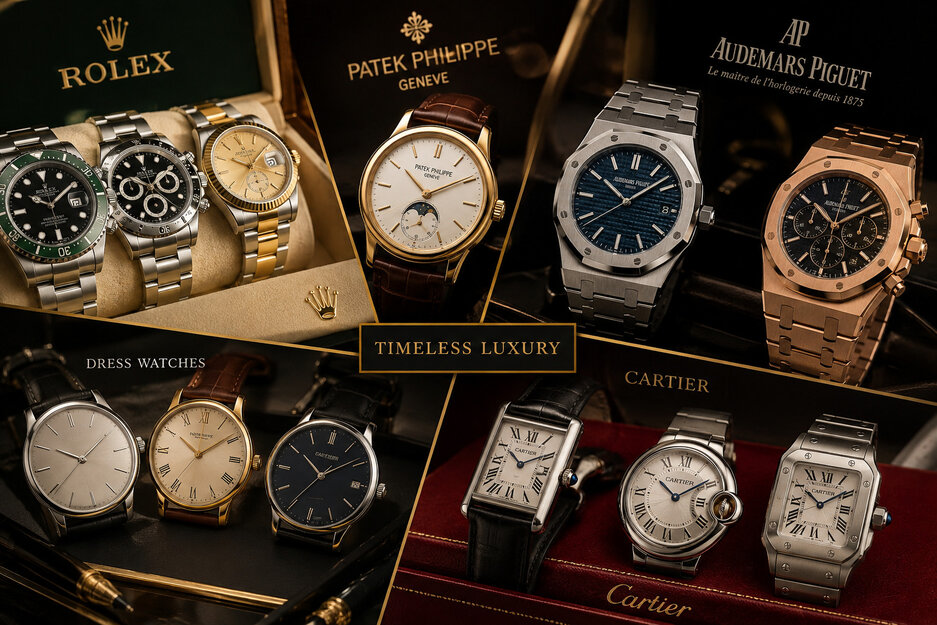
The result is a more discerning approach to watch collecting. While iconic names such as Rolex, Patek Philippe, and Audemars Piguet remain highly sought after, collectors are also exploring independent watchmakers, elegant dress watches, vintage references, and technically exceptional complications.
The Shift From Hype to Collecting With Purpose
The extraordinary demand that surrounded luxury watches during the pandemic has cooled. However, that does not mean interest in exceptional timepieces has disappeared.
Instead, the market has become more selective.
Serious collectors are increasingly distinguishing between watches that simply attract attention and watches that possess qualities capable of sustaining interest for decades.
That distinction matters.
A coveted watch may have strong brand recognition, but collectors also consider craftsmanship, scarcity, historical importance, originality, and condition. Sotheby’s notes that condition remains one of the most important considerations when evaluating collectible watches.
Consequently, today’s collector is often buying with a longer perspective.
Rolex Remains a Cornerstone of Luxury Watch Collecting
Rolex continues to occupy an extraordinary position within the luxury watch world.
Its combination of recognition, heritage, technical development, and broad collector demand makes the brand a natural foundation for many collections.
Iconic families such as the Daytona, Submariner, GMT-Master II, and Datejust continue to attract attention. Yet the modern collector is becoming increasingly knowledgeable about individual references, production periods, dials, bracelets, materials, and provenance.
That creates a deeper appreciation for the differences between seemingly similar watches.
Rolex’s own approach to watchmaking emphasizes precision, reliability, water resistance, self-winding technology, resistance to magnetism, and durability. These characteristics help explain why the brand has maintained such a powerful position among luxury watch enthusiasts.
Patek Philippe Continues to Define Haute Horlogerie
For collectors seeking extraordinary craftsmanship, Patek Philippe remains one of the most important names in fine watchmaking.
The maison’s appeal extends far beyond its famous logo. Collectors are drawn to its complicated movements, restrained designs, historical significance, and exceptional finishing.
Its perpetual calendars, minute repeaters, chronographs, and other complications occupy an especially prestigious position within horology.
Minute repeaters, in particular, represent an extraordinary combination of mechanical complexity and artistry. Sotheby’s describes these watches as sitting at the intersection of rarity and mechanical sophistication.
For the collector, owning such a watch is therefore less about displaying wealth and more about possessing an extraordinary example of mechanical ingenuity.
Audemars Piguet Remains a Collector Favorite
Audemars Piguet continues to command attention among collectors, particularly through the iconic Royal Oak.
The Royal Oak helped redefine luxury sports watches by combining sophisticated mechanical watchmaking with a distinctly architectural design.
Yet today’s collector may look beyond the most recognizable references.
Complications, limited editions, precious-metal models, unusual executions, and historically significant references can offer a deeper collecting experience.
As the market has normalized from its pandemic-era highs, buyers have become more selective. That environment can favor collectors who understand the difference between temporary hype and enduring horological significance.
Independent Watchmakers Are Capturing Attention
Perhaps one of the most fascinating developments in luxury watch collecting is the growing appreciation for independent watchmakers.
Names such as F.P. Journe, Greubel Forsey, De Bethune, Kari Voutilainen, and Laurent Ferrier offer something different from the major maisons.
Their appeal often comes from extremely limited production, distinctive movements, hand-finishing, unconventional designs, and the direct creative vision of the watchmaker.
F.P. Journe has become particularly prominent among collectors. Christie’s has highlighted the brand’s position among the most innovative and sought-after independent watchmakers.
Meanwhile, Christie’s 2025 “Stories in Time” collection demonstrated the extraordinary diversity of contemporary independent watchmaking, featuring names including Greubel Forsey, Ferdinand Berthoud, Voutilainen, and De Bethune.
For collectors, this world offers an opportunity to discover watches that feel genuinely personal and uncommon.
Dress Watches Are Having a Moment
For years, sporty stainless-steel watches dominated conversations around luxury collecting.
Now, elegant dress watches are receiving renewed attention.
Slim profiles, refined proportions, precious metals, and understated dials can provide an entirely different expression of luxury.
This shift reflects a broader movement toward individuality. Chrono24’s analysis of the secondary market found increased interest in slimmer, more design-focused and dressier watches, with Cartier benefiting from this change.
The Cartier Tank and Santos are particularly compelling examples.
Their designs have endured across generations while remaining instantly recognizable. For collectors, that combination of history and elegance can make a dress watch an important complement to a sportier collection.
Cartier Is Becoming Increasingly Important to Collectors
Cartier demonstrates that collectible watches do not always have to follow the traditional sports-watch formula.
The Tank has become one of the most recognizable designs in horology. The Santos, meanwhile, carries its own important history and distinctive character.
Vintage Cartier can also provide collectors with opportunities to explore different eras, materials, proportions, and dial configurations.
The growing interest in Cartier illustrates an important development in modern collecting: luxury watch enthusiasts are increasingly buying watches for design and cultural significance, rather than simply following the most heavily hyped models.
Rare References Are Becoming More Intriguing
Within the world of collecting, rarity can dramatically change the appeal of a watch.
A standard production model may be desirable. A rare reference with an unusual dial, historically important configuration, original components, or documented provenance can become something much more compelling.
Collectors may search for:
- Rare dial variations
- Limited-production references
- Discontinued models
- Historically significant examples
- Original components
- Exceptional condition
- Important provenance
- Boutique or retailer-signed examples
Even seemingly subtle details can matter.
Christie’s, for example, highlights the fascination surrounding double-signed watches. These unusual dials carry the signatures of both the watch manufacturer and the retailer, creating another layer of historical interest for collectors.
Vintage Watches Offer History You Can Wear
Vintage watches occupy a special place within luxury collecting.
Unlike a brand-new timepiece, a vintage watch can carry evidence of another era. Its design, patina, movement, and provenance can tell part of a larger story.
For some collectors, that history is precisely the attraction.
The most desirable vintage watches can also become important auction pieces. Recent auction results demonstrate that truly rare vintage watches remain capable of commanding extraordinary attention. In 2025, a steel Patek Philippe Ref. 1518 achieved $17.6 million at auction, setting a record for a vintage Patek Philippe at auction.
Such results demonstrate the extraordinary potential of exceptional rarity.
However, they should not be interpreted as a guarantee that every vintage watch will appreciate. Collecting should begin with knowledge and passion rather than speculation.
Complications Remain the Ultimate Collector’s Playground
For the serious horology enthusiast, complications can transform a beautiful watch into a miniature mechanical masterpiece.
Perpetual calendars, tourbillons, chronographs, minute repeaters, split-seconds chronographs, and astronomical displays can showcase remarkable technical expertise.
Minute repeaters are particularly revered because of the complexity involved in producing their distinctive chimes.
The attraction is not simply what the watch does. It is how that function is achieved through hundreds of precisely engineered components operating within an extraordinarily small space.
For collectors, such watches represent the intellectual and mechanical side of luxury.
Condition Matters More Than Ever
Two watches of the same reference can have dramatically different appeal depending on their condition.
Collectors examine the case, dial, movement, bracelet, components, and service history. Originality can also become extremely important when evaluating vintage examples.
A watch that has retained original components and strong condition may have greater collector appeal than an example that has undergone extensive replacement or modification.
Sotheby’s collector guidance emphasizes that condition is one of the most important considerations when evaluating a luxury watch.
That makes professional authentication and careful purchasing particularly important when entering the vintage and pre-owned market.
The Rise of the More Informed Collector
Luxury watch collecting is becoming increasingly knowledgeable.
Today’s enthusiasts have access to auction archives, specialist publications, marketplaces, collector communities, historical databases, and detailed brand information.
As a result, collectors can research a reference before purchasing rather than simply relying on brand prestige.
This creates a healthier collecting culture.
Instead of asking only, “What is everyone buying?” sophisticated collectors increasingly ask:
Why does this watch matter?
Is the movement exceptional?
Is the design historically important?
Was production limited?
Does the watch represent an important moment in the brand’s history?
Is the example original?
Does its condition justify the price?
Those questions can lead collectors toward more meaningful acquisitions.
What Makes a Luxury Watch Collectible?
There is no single formula for collectibility.
However, several characteristics repeatedly appear in exceptional collections.
Rarity
Limited production or unusual references can make a watch particularly intriguing.
Craftsmanship
Exceptional finishing and mechanical sophistication can elevate a timepiece beyond conventional luxury.
Heritage
A watch connected to an important period, designer, movement, or technological achievement can gain historical importance.
Condition
Original and well-preserved examples can be particularly desirable.
Provenance
A documented history of ownership can add context and collectibility.
Design
Some watches become icons because their designs remain recognizable across generations.
Personal Connection
Perhaps most importantly, the best watch collection reflects the collector.
A collection does not need to follow the market perfectly. It should tell a story about the person building it.
The Luxury Watch Collection of Tomorrow
The future of luxury watch collecting may be less about chasing the most popular model and more about developing a sophisticated eye.
Established maisons will continue to attract collectors. Rolex, Patek Philippe, Audemars Piguet, and Cartier have earned extraordinary positions through decades of craftsmanship and cultural relevance.
At the same time, independent watchmakers and emerging horological voices offer collectors new opportunities to discover unusual ideas.
The market’s recent normalization has also created a more measured environment. Current data suggests that serious buyers are becoming more selective while interest remains strong in exceptional watches.
That may ultimately benefit luxury watch collecting.
When hype fades, craftsmanship becomes easier to appreciate.
Collecting Beyond the Price Tag
The most compelling luxury watches are not simply expensive objects.
They are expressions of engineering, artistry, history, and human ingenuity.
A great collection might include a legendary sports watch, an elegant dress watch, a complicated Patek Philippe, an independent masterpiece, or a vintage reference with a fascinating story.
What connects them is not necessarily price.
It is significance.
For today’s luxury watch collector, the ultimate acquisition may therefore be the watch that continues to inspire curiosity long after the excitement of the purchase has disappeared.
Because true luxury is not simply owning something rare.
It is understanding why it is rare, why it matters, and why you wanted it in the first place.
Sources
- Hodinkee — The Business of Watches in 2025 and What to Expect in 2026
- Chrono24 — Secondary Watch Market Report H1 2025
- Sotheby’s — Luxury Watches 101: Collector’s Guides
- Sotheby’s — A Collector’s Guide to Assessing Watch Condition
- Christie’s — A Collector’s Guide to F.P. Journe Watches
- Christie’s — Double-Signed Watches: A Collector’s Guide
- Rolex — Watchmaking: Excellence in the Making